Burnout persists for DFW PR pros, even as career satisfaction holds steady
Story and Strategy survey shows workload strain and “always on” expectations continue to shape the profession
Work-life balance remains a stubborn pressure point for communications professionals in Dallas-Fort Worth, even as most say they are satisfied with their careers.
New 2026 survey data compiled by Story and Strategy shows stress levels edged up slightly year over year, from 3.44 to 3.48 on a five-point scale. Work-life balance moved in the opposite direction, slipping from 3.42 to 3.38. The changes are modest, but they point to a familiar reality for public relations professionals: the job still demands constant responsiveness, flexibility and emotional bandwidth.
The strain shows up most clearly in how people describe their workloads. Nearly two-thirds of respondents, 63%, said their workload feels only somewhat sustainable. Another 19% called it unsustainable, and 5% said they are actively burning out.
The data suggests many professionals are keeping up with the pace of work, but not in a way they believe can last.
Day-to-day pressures helps explain why.
Heavy workload and overtime topped the list of stress drivers, while organizational changes and uncertainty followed, along with constant connectivity. Tight deadlines and the need to be “always available” remain core features of the job.
Long hours reinforce that pattern. More than two-thirds of respondents said they typically work 40 to 50 hours per week, while another 22% reported working more than 50 hours.
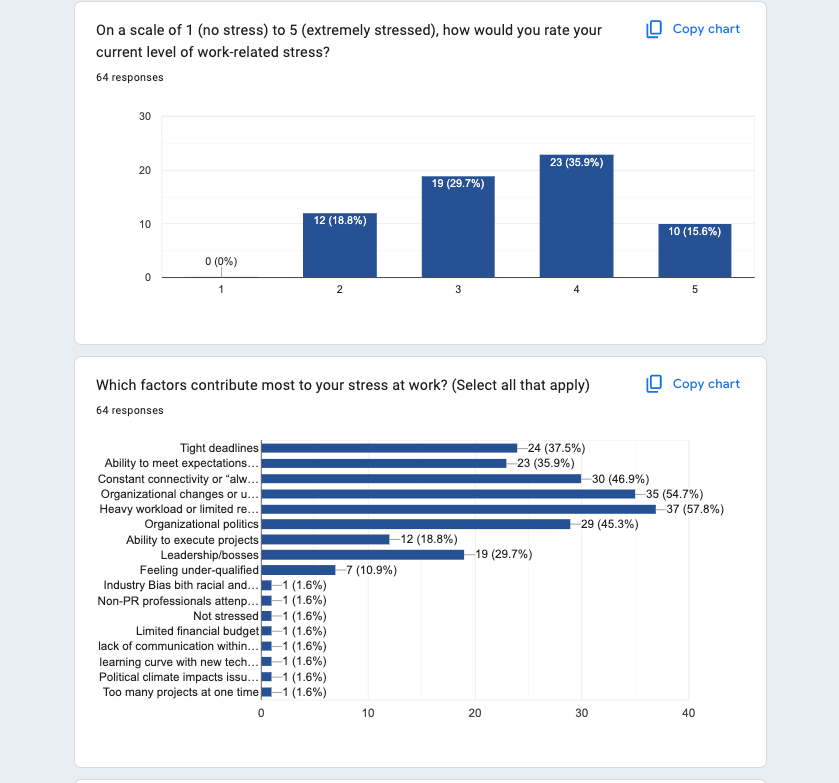
Data from the 2026 State of Communications in DFW Survey
Time off is not always delivering relief.
While more professionals are taking extended vacations, the ability to disconnect has eroded. The share of respondents taking 16 or more days off rose to 27%, up from 20% the previous year. But those who said they are always on while away from work climbed from 2% to 11%. The share who unplug completely dropped from 15% to 8%.
For many, vacation is no longer a true break.
Structural fixes needed rather than coping strategies.
Half said additional headcount would most improve work-life balance. Other top responses included fewer meetings, clearer priorities from leadership and more realistic deadlines.
Recognition from leadership plays a role in how professionals experience that workload. Only 25% of respondents said they feel “very valued” by leadership, down from 27% last year and below the national benchmark of 37% reported in Muck Rack’s State of PR 2025.
Feeling valued is tied less to compensation and more to influence and trust. Respondents ranked inclusion in strategic decisions as the top factor, followed by autonomy and confidence from leadership. Pay and promotions ranked lower as drivers of perceived value.
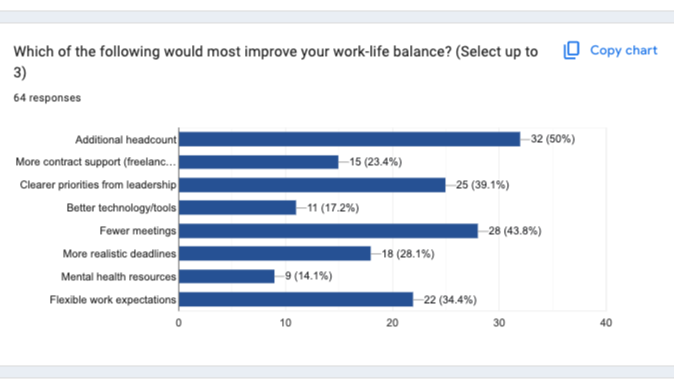
Data from the 2026 State of Communications in DFW Survey
Compensation concerns are rising.
The share of respondents who said they feel significantly underpaid jumped from 18% to 31% year over year, suggesting a growing gap between expectations and reality as responsibilities expand.
Despite those pressures, career satisfaction remains strong. Nearly half of respondents rated their satisfaction a 4 out of 5, and another 33% gave a 5. Only 6% rated their satisfaction at 2 or below.
That contrast defines the current state of the profession in DFW. Communications professionals remain committed to their work and see value in what they do. At the same time, many question whether the way the work is structured is sustainable.
The data points to a profession that still attracts and retains talent, but asks more of its people than many believe it should.
About the State of Communications in DFW Report
The State of Communications in DFW Report provides a data-driven look at the experiences of public relations and communications professionals across the Dallas-Fort Worth region. Based on responses from local practitioners working across agencies, in-house teams and nonprofits, the survey examines workload, stress, work-life balance, career satisfaction and perceptions of leadership.
Designed to inform industry conversations at the local level, the 2026 State of Communications in DFW Report offers actionable insight for communications leaders, teams and organizations looking to better support the people behind their work.