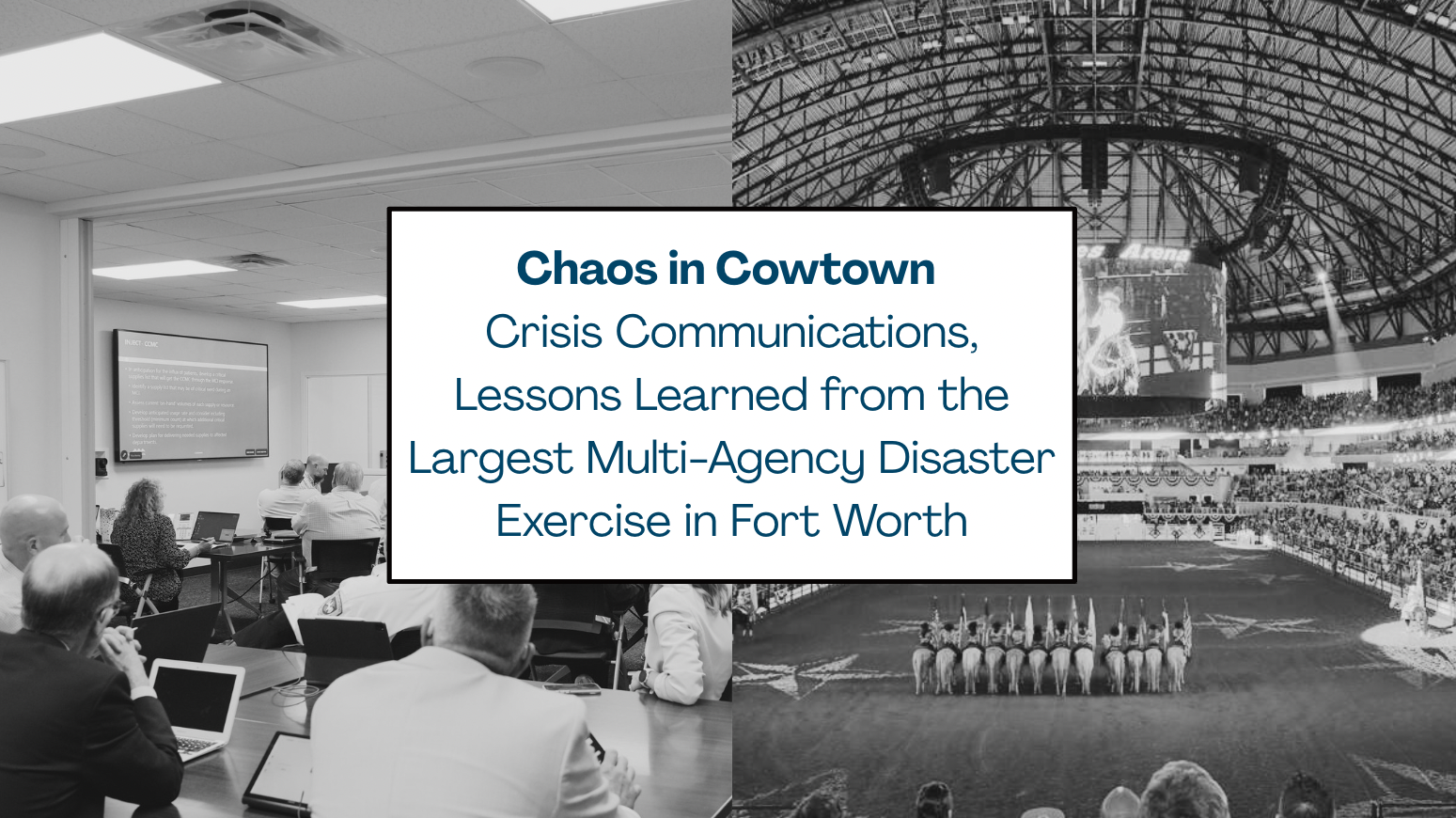
Lessons from "Chaos in Cowtown," a landmark crisis communications exercise, reveals what happens when the people who manage incidents and the people who manage the message aren't prepared to work as one.
By Kim Brown, APR
With more than a million visitors over a 23-day period, the Fort Worth Stock Show and Rodeo is one of the largest annual events in North Texas and easily one of the most complex crisis scenarios imaginable. In September 2024, that setting served as the backdrop for one of the most ambitious multi-agency disaster exercises in Fort Worth history. The drill simulated the collapse of a building during the event, forcing emergency managers, communications professionals, hospitals and city agencies to respond in real time.
At the 2026 AHEPP Healthcare Emergency Preparedness Professionals Conference in Frisco, Texas, I had the privilege of presenting "Chaos in Cowtown" alongside Kaysey Pollan, MBA, CHSP, Director of System Preparedness and Continuity at Cook Children's Health Care System in Fort Worth. Our goal was simple: to make the case that emergency managers and communications professionals must stop operating in silos and start working together.
"From the moment an incident occurs, the clock starts ticking. That window between the first social media post and your first approved statement? That is where you can lose the narrative - and public trust - entirely."
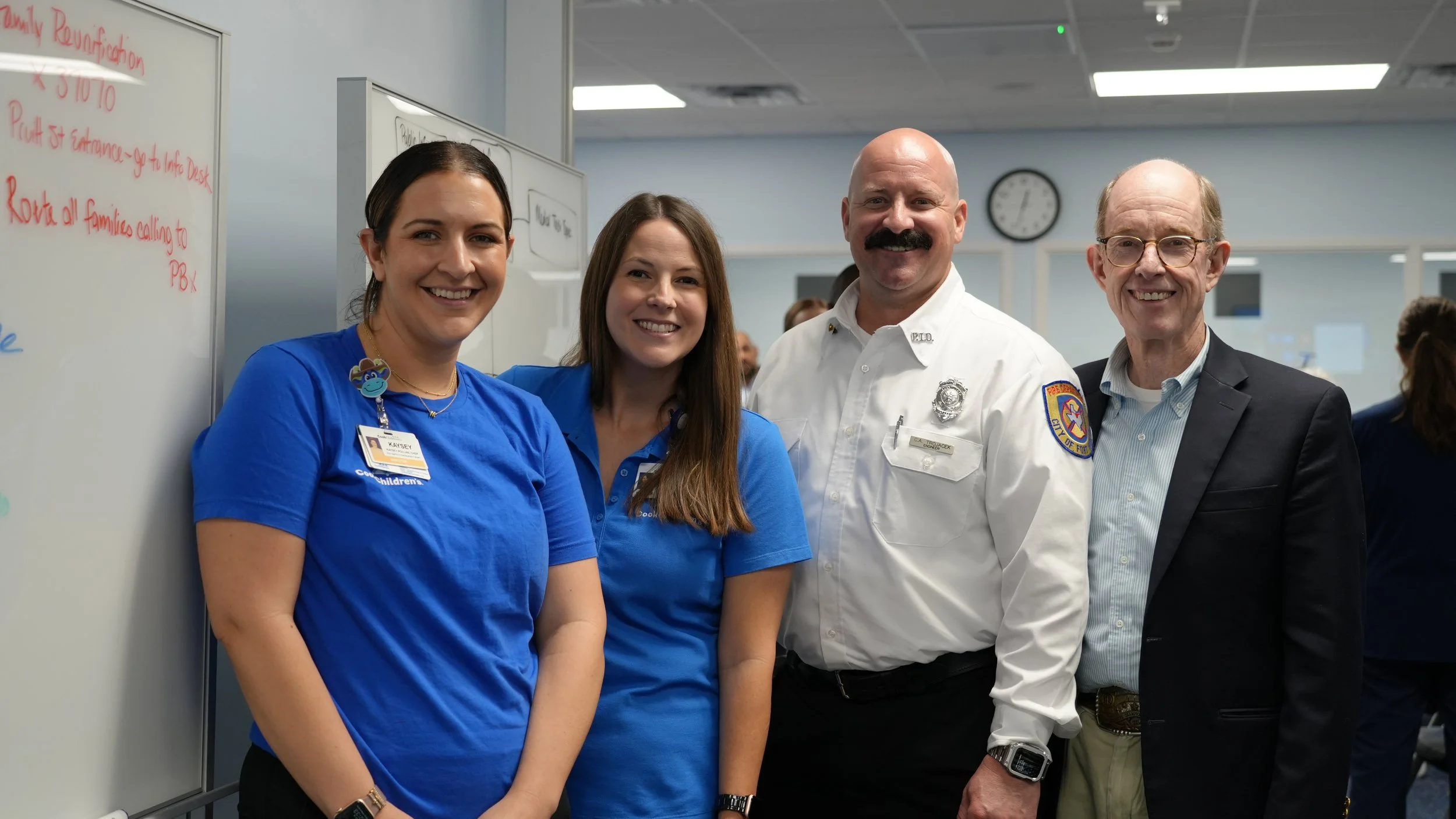
Kaysey Pollan, Kim Brown, Craig Trojacek of Fort Worth Fire Dept., Matt Brockman of Fort Worth Stock Show and Rodeo
TWO WORLDS, ONE CRISIS
Emergency managers are trained to manage incidents. Crisis communicators are trained to manage the message. In a real mass casualty event, both functions are happening simultaneously, at speed, under pressure and too often, the people responsible for each have little experience working together.
That disconnect is more common than many organizations realize. Emergency managers routinely collaborate with external partners: EMS, fire departments, police, hospitals. But communicators tend to be heads-down in their own organizations, without the broader community relationships that a major incident demands. That is a gap emergency managers are uniquely positioned to close, by making introductions and pointing their communications counterparts toward the network of partners they will need if a citywide mass casualty incident occurs.
Those partners typically include:
Emergency Management and the Office of Emergency Management
Emergency Medical Services (EMS)
Police and Fire Departments
Hospitals and healthcare coalitions
City leadership
Event organizers
Volunteer organizations such as the American Red Cross
Establishing those relationships before a crisis is foundational.
WHY THE FORT WORTH STOCK SHOW AND RODEO?
One of the first questions we pose to audiences is this: What major events or scenarios in your community should be driving your drill planning? Too often, organizations design abstract exercises disconnected from the realities of their environment. We encourage a different approach. Look at what is already happening in your backyard and build from there.
The Fort Worth Stock Show and Rodeo was an obvious choice for us. More than 1.2 million visitors attend over 23 days, the majority from out of town. Many would be unfamiliar with the five trauma centers located in Fort Worth's hospital district. A structural collapse during the event would create an immediate mass casualty situation with a highly diverse, largely transient patient population.
Kaysey urged conference attendees to think beyond the event itself and consider what would make any given scenario more complicated. Key complicating factors in a real-world exercise include:
A wide range in patient ages, including pediatric populations
Multiple hospital systems with varying protocols and cultures
Language barriers among patients, families and bystanders
A patient population with limited familiarity with local healthcare resources
Designing around these realities, rather than a generic scenario, makes the exercise and the lessons far more meaningful.
EIGHT MONTHS OF PLANNING - AND WHAT WE FOUND
Our team spent eight months planning the drill. That gave us time to dig deep into not only logistics, but ethos. As we brought multiple organizations to the table, we quickly discovered information gaps that would have been catastrophic in a real incident.
Expectations among partner organizations about what information would be released publicly, and how it would flow up through the incident chain of command, were not aligned. Social media protocols, specifically, what hospitals would post versus what incident command would post, varied significantly across organizations.
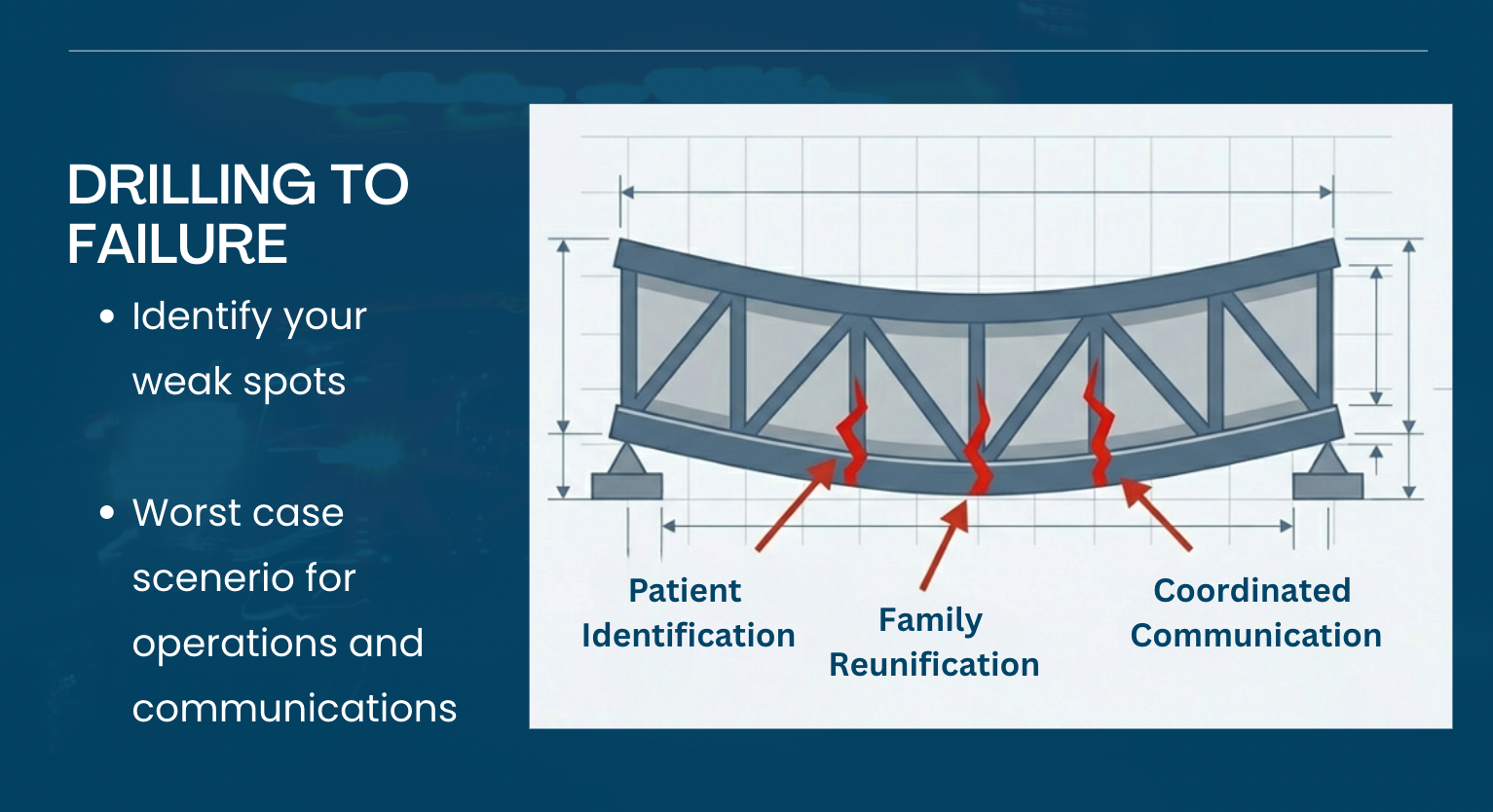
These were not surprises. We knew they were there. But the critical insight from our experience is this: we did not solve them ahead of time. Kaysey’s guiding principle for the drill was to design for failure, that is to let the problems play out in the exercise so they could be identified and addressed before a real incident made them catastrophic.
"We wanted to design the drill without solving the problems ahead of time. Drill to failure, and you find your weak spots. That is the whole point." - Kaysey Pollan, MBA, CHSP
DRILLING TO FAILURE - ON PURPOSE
When the exercise ran, we watched known vulnerabilities surface in real time. Patient identification was difficult. Family reunification processes broke down. Coordinated communication between organizations faltered. These are uncomfortable things to watch and exactly what a drill is designed to surface.
Kaysey was direct with conference attendees: drill, and drill to the tempo of reality. If it looks real, it feels real. That means using moulage to create realistic injuries, bringing in role players, and ensuring that all the agencies and resources that would respond in an actual incident are represented. A sanitized, low-stakes exercise produces sanitized, low-value lessons.
One of the clearest demonstrations of this principle came from a technology failure. Communicators planned to coordinate via Microsoft Teams during the exercise. With so many different organizations involved, each with varying levels of access and familiarity with the platform, it did not work. The backup plan, a GroupMe group, succeeded where Teams failed. That lesson cost nothing in a drill. In a real incident, it could have cost hours of coordination time.
THE NARRATIVE GAP: A CRISIS COMMUNICATOR'S GREATEST RISK
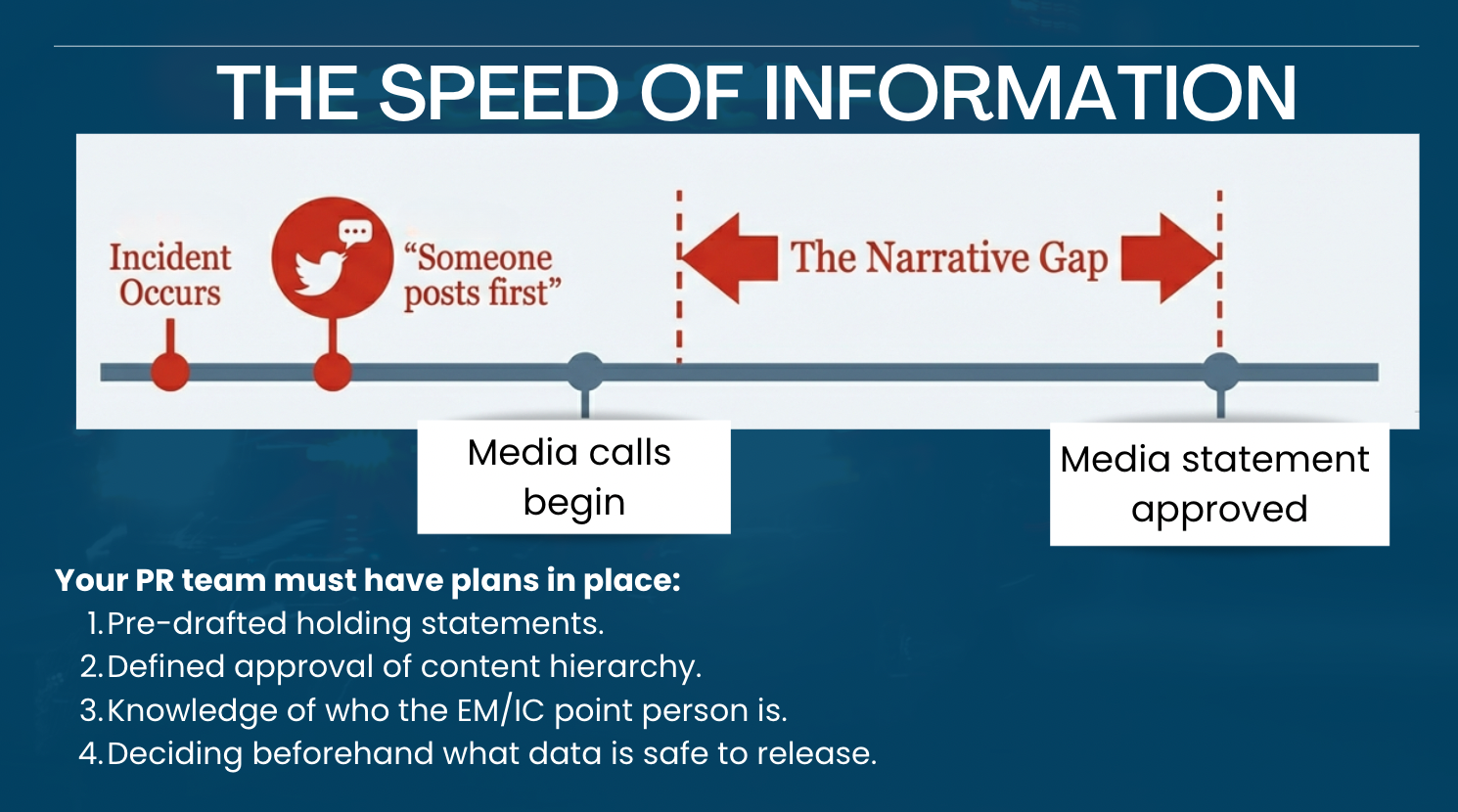
From a crisis communications standpoint, one of the most important concepts I shared with attendees is the narrative gap: the window between when an incident begins and when your organization releases its first approved statement.
The moment something happens, someone nearby pulls out their phone. Social media posts go up within minutes. Media calls follow shortly after. The time between those first calls and your first statement is when you are most at risk of losing control of the story. Research in psychology is clear: people tend to believe the first information they receive, and it is extraordinarily difficult to correct the record once someone else has shaped the narrative.
That is why the concept of the ‘golden hour’ matters so deeply in crisis communications. Waiting until an incident is underway to draft your first public statement is too late. Holding statements should be pre-drafted, vetted and ready to deploy. Crisis communications plans should include templates for different scenarios, and emergency managers are invaluable partners in helping communications teams understand what scenarios are most likely given their environment.
WHAT A REAL CRISIS COMMUNICATIONS PLAN LOOKS LIKE
A functional crisis communications plan is not a two-page document saved somewhere on a shared drive. It is a comprehensive, living document, often 50 to 100 pages or more (depending on the size of your organization) that includes:
Clear outline of the crisis communication team and crisis response process
A clear chain of command for communication flow (i.e. who’s approving statements before release)
Guidance on what information can be released publicly and what must be withheld
Pre-drafted holding statement templates (generic and for likely scenarios)
Contact information for all internal and external stakeholders
Protocols for social media management during an active incident
An overview of ICS structure and how communications integrates within it
Specific scenario guidance so communicators are not learning processes mid-crisis
That last point is worth emphasizing. You do not want your communications team learning, in the middle of a hazmat spill, what the protocols for a hazmat spill are… while their phones are ringing with media calls and social media is erupting with unverified information. The time to learn is before. The plan is the bridge between preparation and execution.
EMERGENCY MANAGERS: YOUR COMMUNICATIONS COLLEAGUES NEED YOUR HELP
If there is one message to carry back to emergency managers from our presentation, it is this: your communications counterparts may be operating in a different professional language than you are, and it is worth the effort to bridge that gap.
For communications professionals who come from media backgrounds or non-governmental organizations, the Incident Command System may be entirely new territory. Acronyms that are second nature to emergency managers can be puzzling to someone whose career has been built around pitching stories and managing press relationships. Emergency managers should help their communications peers understand how to access ICS training, through FEMA and other available resources, and ensure they have a working understanding of how information flows during an incident before one occurs.
It is also important to recognize that different organizations and different patient populations bring different cultural norms to crisis response. The expectations and comfort levels around information released in a pediatric health care system, for example, may differ meaningfully from those in an adult trauma center. These differences need to be discussed at the planning table, not discovered during a real event.
PREPARE TOGETHER
What "Chaos in Cowtown" ultimately demonstrated is that trust in an organization's reputation during a crisis is not built in the moment of the crisis. It is forfeited in the months and years of preparation that precede it.
Emergency managers and communications professionals are natural allies in that preparation. They protect different but equally essential interests: operational integrity and public trust. When they train together, plan together and build relationships with the same community partners, organizations are positioned to respond with both competence and credibility when it matters most.
The chaos will come. The question is whether your team is ready for it.
About the Presenters
Kaysey Pollan, MBA, CHSP is Director of System Preparedness and Continuity at Cook Children's Health Care System in Fort Worth, Texas.
Kim Brown, MA, APR is Co-founder of Story and Strategy, a boutique PR and crisis communications firm in Fort Worth, Texas.
This presentation was delivered at the Association of Healthcare Emergency Preparedness Professionals Conference in Frisco, Texas.
Ready to put your crisis plan to the test? Or perhaps start one? Let us help you!