817 Biz Column: PR to build credibility is a must-have in the AI era
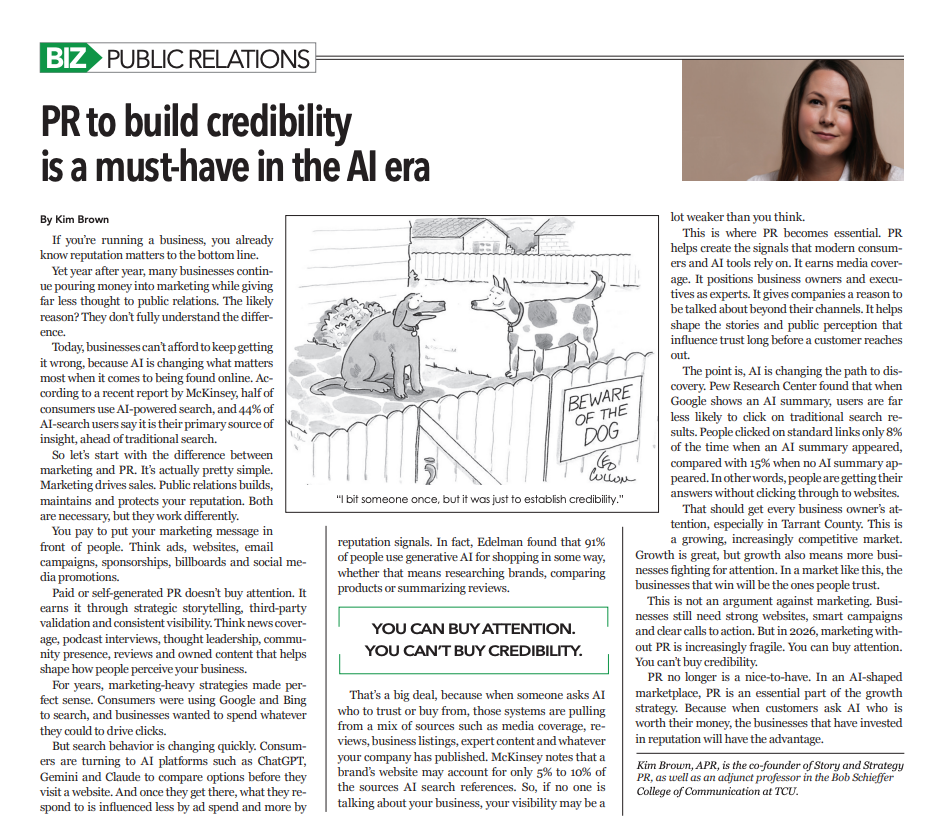
Published in the May 2026 issue of 817 Biz.
By Kim Brown, APR, co-founder of Story and Strategy
If you’re running a business, you already know reputation matters to the bottom line. Yet year after year, many businesses continue pouring money into marketing while giving far less thought to public relations. The likely reason? They don’t fully understand the difference.
Today, businesses can’t afford to keep getting it wrong, because AI is changing what matters most when it comes to being found online. According to a recent report by McKinsey, half of consumers use AI-powered search, and 44% of AI-search users say it is their primary source of insight, ahead of traditional search.
So let’s start with the difference between marketing and PR. It’s actually pretty simple. Marketing drives sales. Public relations builds, maintains and protects your reputation. Both are necessary, but they work differently.
You pay to put your marketing message in front of people. Think ads, websites, email campaigns, sponsorships, billboards and social media promotions.
Paid or self-generated PR doesn’t buy attention. It earns it through strategic storytelling, third-party validation and consistent visibility. Think news coverage, podcast interviews, thought leadership, community presence, reviews and owned content that helps shape how people perceive your business.
For years, marketing-heavy strategies made perfect sense. Consumers were using Google and Bing to search, and businesses wanted to spend whatever they could to drive clicks.
But search behavior is changing quickly. Consumers are turning to AI platforms such as ChatGPT, Gemini and Claude to compare options before they visit a website. And once they get there, what they respond to is influenced less by ad spend and more by reputation signals. In fact, Edelman found that 91% of people use generative AI for shopping in some way, whether that means researching brands, comparing products or summarizing reviews.
That’s a big deal, because when someone asks AI who to trust or buy from, those systems are pulling from a mix of sources such as media coverage, reviews, business listings, expert content and whatever your company has published. McKinsey notes that a brand’s website may account for only 5% to 10% of the sources AI search references. So, if no one is talking about your business, your visibility may be a lot weaker than you think.
This is where PR becomes essential. PR helps create the signals that modern consumers and AI tools rely on. It earns media coverage. It positions business owners and executives as experts. It gives companies a reason to be talked about beyond their channels. It helps shape the stories and public perception that influence trust long before a customer reaches out.
The point is, AI is changing the path to discovery. Pew Research Center found that when Google shows an AI summary, users are far less likely to click on traditional search results. People clicked on standard links only 8% of the time when an AI summary appeared, compared with 15% when no AI summary appeared. In other words, people are getting their answers without clicking through to websites.
That should get every business owner’s attention, especially in Tarrant County. This is a growing, increasingly competitive market. Growth is great, but growth also means more businesses fi ghting for attention. In a market like this, the businesses that win will be the ones people trust.
This is not an argument against marketing. Businesses still need strong websites, smart campaigns and clear calls to action. But in 2026, marketing without PR is increasingly fragile. You can buy attention. You can’t buy credibility.
PR no longer is a nice-to-have. In an AI-shaped marketplace, PR is an essential part of the growth strategy. Because when customers ask AI who is worth their money, the businesses that have invested in reputation will have the advantage.
Interested in learning how PR can boost your business? Contact us!